Plumbing Inspections vs. Customer Service Inspections: What Texas Public Water Systems Need to Know
FLO by HAC . . 4 min read
In Texas, a plumbing inspection doesn’t always satisfy Customer Service Inspection (CSI) requirements. Learn why CSIs are critical to protecting public water systems—and how HAC and FLO can help utilities simplify inspections, backflow compliance, and ongoing program management.

In Texas, a plumbing inspection and a Customer Service Inspection (CSI) can sometimes occur at the same time—but they are not necessarily the same thing.
A plumbing inspector's primary responsibility is to verify that plumbing has been installed in accordance with the plumbing code adopted by the local jurisdiction, typically the International Plumbing Code (IPC) or Uniform Plumbing Code (UPC). These codes contain important requirements related to backflow prevention and cross-connections.
However, a plumbing inspection alone may not satisfy all requirements applicable to a public water system (PWS) under Texas Commission on Environmental Quality (TCEQ) rules.
That distinction matters because the public water system is ultimately responsible for protecting its distribution system from potential contamination caused by cross-connections.
Why Is a Customer Service Inspection Necessary?
A Customer Service Inspection focuses specifically on conditions that could create a cross-connection or otherwise present a potential contamination hazard to the public water supply.
Even when a property passes its plumbing inspection, additional measures may be necessary to meet the public water system's cross-connection control requirements. This can be particularly important when the local plumbing code has not been amended to fully address requirements established by TCEQ or by the water purveyor's own cross-connection control program.
Depending on the circumstances, a CSI may identify issues such as improper cross-connections, inadequate backflow protection, or other conditions requiring correction.
When deficiencies are identified, they must be addressed in accordance with the public water system's requirements. For new construction or changes in service, completion of the CSI may also be tied to establishing water service or the local Certificate of Occupancy process.
When the City and Water Provider Are Different
Coordination becomes especially important when the entity performing building and plumbing inspections is not the same entity supplying drinking water.
For example, a city may issue building permits and conduct plumbing inspections while a separate municipality, utility district, water supply corporation, or other public water system provides the property's drinking water.
In these situations, passing the city's plumbing inspection does not eliminate the water provider's responsibility to verify that required Customer Service Inspections and cross-connection control measures have been completed.
Clear communication among the customer, plumbing or building department, CSI provider, and water purveyor can help prevent gaps in compliance.
Customer Service Inspections Shouldn't End With New Construction
Cross-connection risks can change over time.
Commercial and higher-hazard facilities—including hospitals, manufacturing facilities, laboratories, industrial operations, and facilities using chemicals or specialized equipment—may undergo significant plumbing and operational changes after their initial inspection.
New equipment may be installed. Production processes may change. Irrigation systems may be modified. Chemical feed equipment, boilers, medical equipment, or other water-using devices may be added.
For this reason, a public water system may establish a periodic CSI or re-inspection program based on facility type, degree of hazard, historical compliance, or other risk factors.
A risk-based inspection schedule helps the utility focus its resources where a cross-connection could have the greatest potential impact.
Managing CSIs Is a Program—not Just an Inspection
For a public water system, completing the inspection is only one part of an effective cross-connection control program.
Utilities also need a reliable way to determine:
Which facilities require a CSI
Which facilities have never been inspected
Which inspections are approaching their due date
Which facilities are overdue or non-compliant
Which corrective actions remain unresolved
Which backflow prevention assemblies are current or overdue for testing
When notices and follow-up communications were sent
Without a centralized process, those responsibilities can quickly become difficult to track—especially for systems managing hundreds or thousands of facilities and backflow prevention assemblies.
Turning Cross-Connection Data Into Action with FLO
FLO by Hardin & Associates Consulting (HAC) helps public water systems organize and manage cross-connection control program information in one place.
Rather than relying on separate spreadsheets, inspection files, test reports, and reminder lists, utilities can use FLO to gain a clearer picture of program compliance.
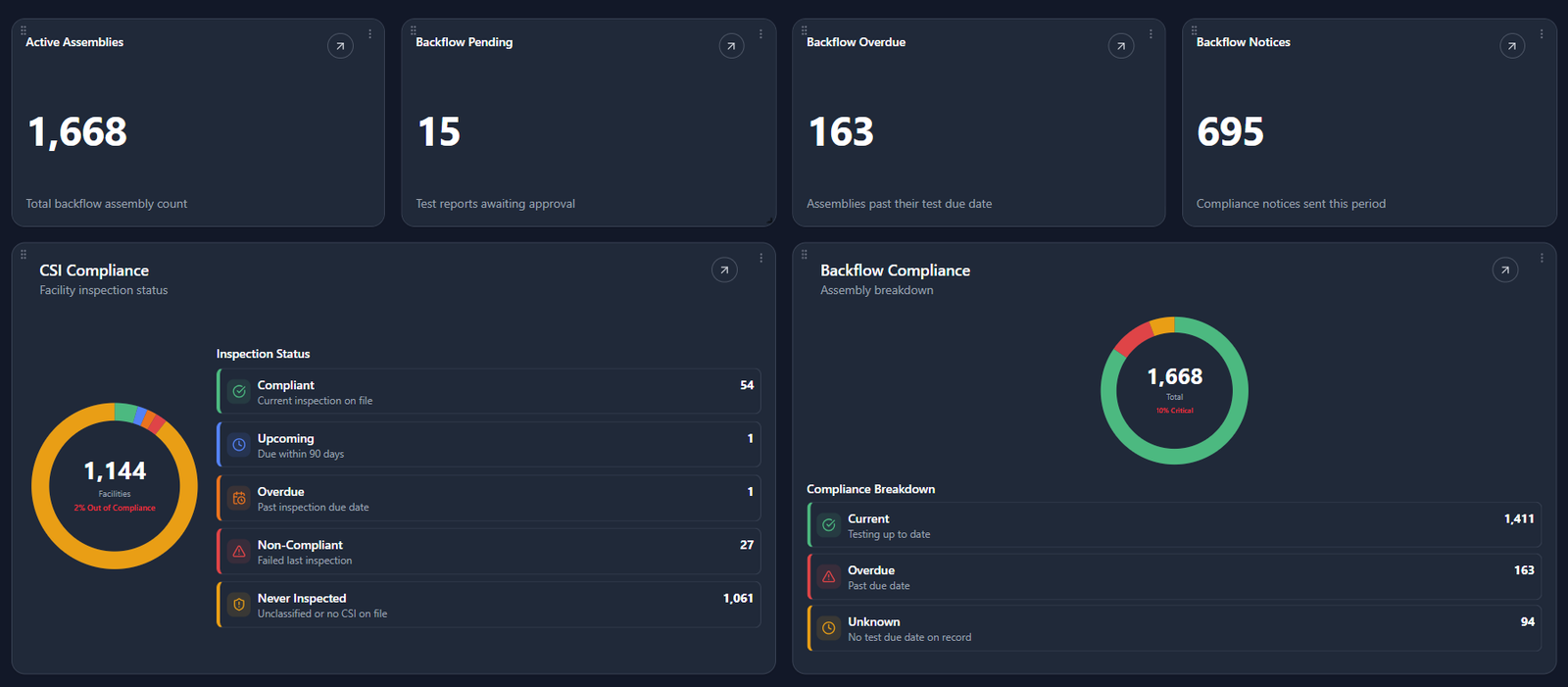
A dashboard can provide staff with an at-a-glance view of key indicators, such as CSI compliance, facilities that have never been inspected, overdue inspections, active backflow assemblies, overdue assembly tests, pending test reports, and compliance notices.
That visibility helps turn inspection and testing data into an actionable compliance workflow.
[Suggested image placement: FLO Compliance Dashboard]
Example caption: A centralized FLO dashboard gives public water systems visibility into CSI and backflow compliance, helping staff quickly identify overdue inspections, untested facilities, pending reports, and assemblies requiring attention.
For example, instead of discovering an overdue CSI during a manual file review, staff can identify compliance gaps directly from the dashboard and prioritize follow-up based on risk and status.
FLO can support the administrative side of the program while HAC's cross-connection control professionals can assist with the services needed to implement it.
More Than Software: Cross-Connection Control Program Support
Every public water system is different. HAC can support utilities with individual services or a more comprehensive cross-connection control program, including:
Customer Service Inspections and periodic re-inspections
Cross-connection control program development and evaluation
Backflow prevention program support
Compliance tracking and follow-up
Data organization and program management
FLO cross-connection control software
Training and continuing education for water professionals
Regulatory and TCEQ compliance support
The goal is not simply to complete an inspection. It is to establish a defensible, manageable process that helps the public water system identify hazards, document compliance, follow up on deficiencies, and protect the drinking water distribution system over time.
Is Your CSI Program Keeping Up?
Plumbing inspections are an important part of protecting buildings and their occupants, but public water systems have an additional responsibility: protecting the public drinking water supply from cross-connections and potential contamination.
A well-managed Customer Service Inspection program helps bridge that gap.
Whether your utility needs help establishing a periodic inspection program, addressing a backlog of facilities, improving backflow compliance, organizing program data, or implementing a centralized system such as FLO, Hardin & Associates Consulting can help.
Contact HAC
For questions about Customer Service Inspections, Cross-Connection Control program support, or FLO:
Email: flo@hactexas.com
Phone: 972.823.8800